
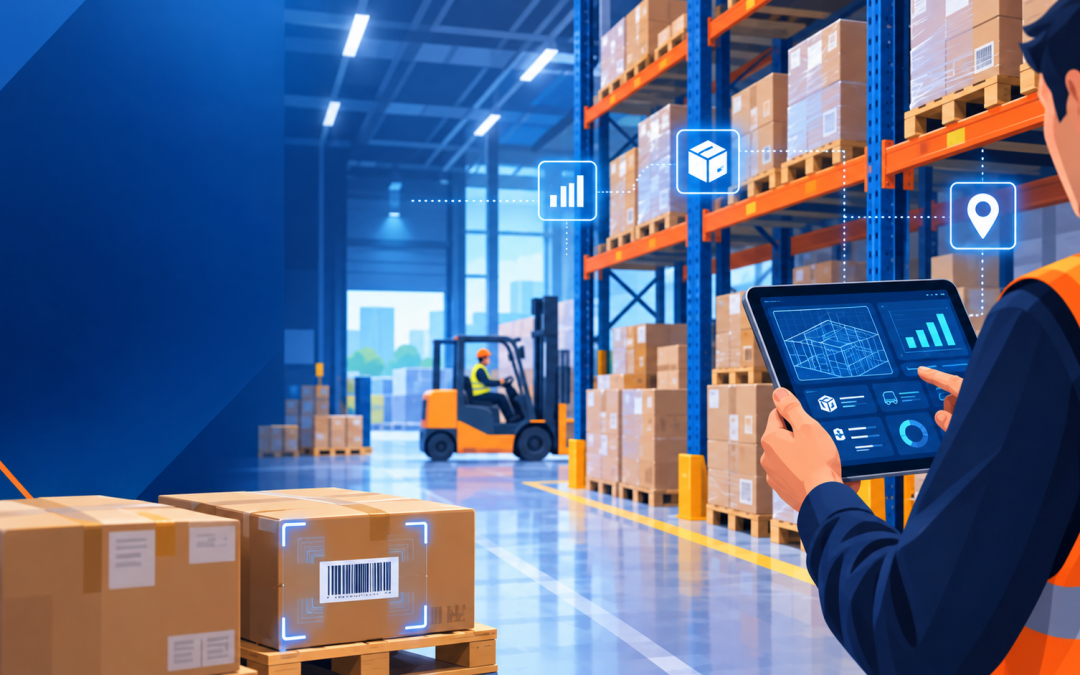
A WMS (Warehouse Management System) is software designed to manage, control, and optimize day-to-day warehouse operations. It helps companies coordinate inventory, locations, receiving, picking, packing, shipping, and internal movements while giving teams greater visibility into what is happening across the warehouse in real time.
In simple terms, a WMS connects inventory, people, processes, and data so warehouse operations can run with more accuracy, consistency, and control.
What Does a WMS Do?
A Warehouse Management System supports the main processes that take place inside a warehouse or distribution center:
📥 Receiving — Manage inbound goods and confirm what has arrived.
🏷️ Identification and labeling — Assign labels, barcodes, or other identification methods.
📍 Putaway and location management — Direct inventory to the right storage location.
🔄 Internal movements — Track transfers and product movements within the facility.
📊 Inventory visibility — View stock levels, locations, and availability.
🔁 Replenishment — Move inventory where it is needed to support picking operations.
🛒 Order picking — Guide warehouse teams through the order preparation process.
✅ Product verification — Validate items and quantities before orders move forward.
📦 Packing — Organize and confirm products before shipment.
🚚 Shipping — Manage outbound orders and dispatch processes.
🔢 Cycle counting and inventory counts — Support more accurate inventory control.
🔎 Traceability — Record warehouse activity and track each movement throughout the operation.
Why Do Companies Use a WMS?
As warehouse operations grow, manual processes and disconnected systems can make it harder to maintain control. A WMS helps reduce that complexity by giving teams a structured way to execute tasks and access accurate information.
Some of the main benefits include:
📦 Better inventory accuracy — Know what inventory is available and where it is located.
⚡ Faster warehouse operations — Reduce unnecessary steps and improve task execution.
❌ Fewer picking and shipping errors — Use validations and guided workflows to improve accuracy.
📍 Improved space utilization — Organize inventory based on warehouse rules and available locations.
🔎 Greater traceability — Keep a record of movements, users, tasks, and inventory activity.
📊 Real-time visibility — Give warehouse managers better information for daily decision-making.
📈 Scalability — Support higher order volumes, more SKUs, and more complex operations as the business grows.
WMS vs. ERP: What Is the Difference?
An ERP manages broader business processes such as purchasing, sales, accounting, billing, and financial information. A WMS focuses on the physical execution of warehouse operations.
For example, an ERP may show that a company has 500 units of a product in inventory. A WMS can show where those units are stored, which are available, which are allocated, and what warehouse activity has taken place around them.
That is why ERP and WMS platforms often work together rather than replace one another.
How Do You Know If You Need a WMS?
A WMS may be worth considering if your operation is experiencing:
⚠️ Frequent inventory discrepancies
🔍 Difficulty locating products
❌ Picking or shipping errors
🧠 Too much dependence on individual employee knowledge
📋 Heavy use of spreadsheets or manual controls
🔎 Limited traceability
📈 Increasing order volumes
🏬 More SKUs, storage locations, or warehouse facilities
⏱️ Limited real-time visibility into warehouse activity
🔗 A need to integrate warehouse operations with ERP, e-commerce, or other systems
When these issues begin affecting productivity, service levels, or the ability to scale, a WMS can help create a more controlled and efficient warehouse environment.
GT WMS: More Than Warehouse Software
At GlobalTech, we see WMS implementation as more than installing technology. Every warehouse has its own processes, products, systems, and operational challenges, so the solution must fit the way the business actually works.
With GT WMS, the goal is to combine technology, logistics expertise, system integration, and ongoing support to help companies improve warehouse performance and build more scalable operations.
GT WMS Nova: A Modern Warehouse Management Experience
GT WMS Nova is a web-based platform designed to simplify warehouse management while providing real-time operational information and a more intuitive user experience.
Its focus is simple: make warehouse operations easier to manage without sacrificing control, visibility, or operational power.
🎥 Learn more about GT WMS Nova
🎥 See how companies are improving their logistics operations with GlobalTech
A WMS Is Not Just About Inventory
A WMS is not simply a tool for knowing how much stock is available. It provides the structure needed to manage how inventory moves through the warehouse, how teams execute tasks, and how information supports better decisions.
For growing businesses, the question is not only “Do we know what inventory we have?” but also “Can our warehouse operation support where the business is going next?”
GT WMS helps companies connect technology, warehouse processes, and operational data to build more accurate, visible, and scalable warehouse operations.
