
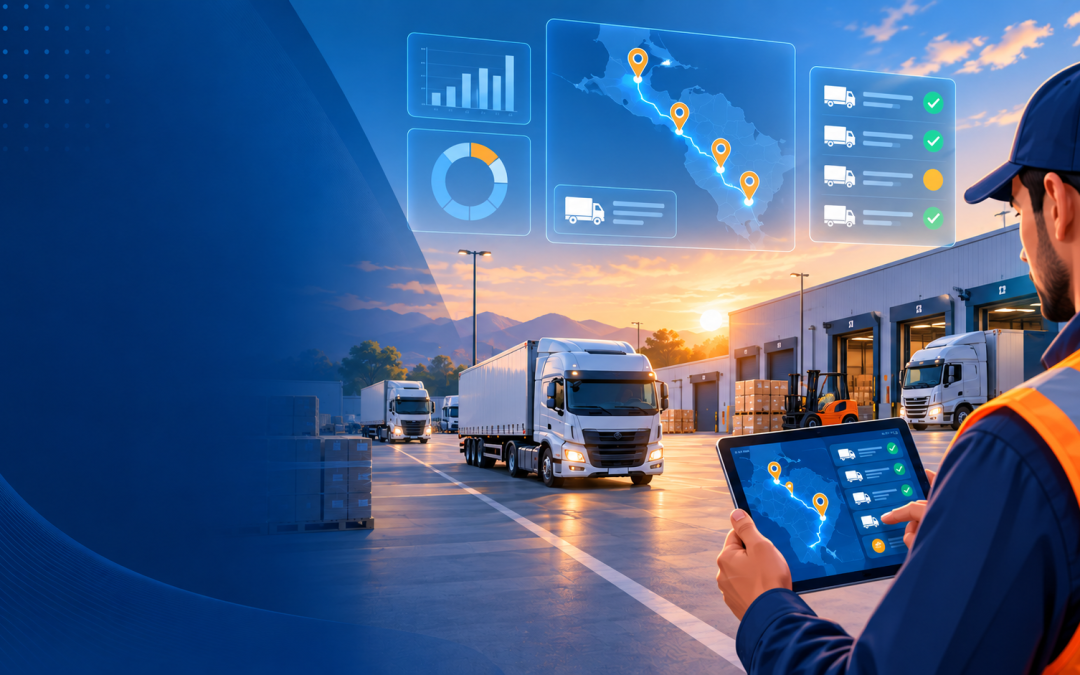
A TMS (Transportation Management System) is software designed to plan, manage, track, and optimize transportation and distribution operations. It helps companies organize orders, routes, carriers, vehicles, drivers, deliveries, costs, and logistics events from one centralized platform.
In simple terms, a TMS connects orders, transportation, people, and data so companies can manage deliveries with greater visibility, control, and efficiency.
What Does a TMS Do?
A Transportation Management System supports the main processes involved in distribution and delivery operations:
🚚 Fleet and carrier management — Organize company-owned fleets and third-party transportation providers.
🗺️ Route planning and optimization — Build more efficient routes based on destinations, resources, and delivery requirements.
📦 Order management and assignment — Group and assign orders to vehicles, routes, or carriers.
👨✈️ Driver and vehicle management — Manage drivers, vehicles, and transportation resources.
📍 Delivery tracking — Monitor order status and transportation events in real time.
🔔 Alerts and exceptions — Identify delays, incidents, or changes that may affect deliveries.
📱 Mobile execution — Allow drivers and field teams to update delivery activity while on the road.
✅ Proof of Delivery (POD) — Capture delivery confirmation, signatures, images, or related documentation.
💰 Transportation cost control — Improve visibility into freight and delivery costs.
📊 KPIs and reporting — Track OTIF, costs, service levels, delivery performance, and other metrics.
🔗 System integration — Connect transportation operations with ERP, WMS, e-commerce, and other business systems.
Why Do Companies Use a TMS?
As distribution operations grow, transportation becomes more complex. More orders, more destinations, more carriers, and higher customer expectations can make manual planning difficult to scale.
A TMS helps companies bring more structure and visibility to that process.
Some of the main benefits include:
🗺️ More efficient route planning — Reduce unnecessary mileage and improve resource utilization.
🚚 Better fleet and carrier coordination — Manage owned and outsourced transportation in one place.
📍 Real-time delivery visibility — Know what is happening with each order after it leaves the warehouse.
❌ Fewer delivery issues — Detect exceptions earlier and reduce failed or delayed deliveries.
💰 Better cost control — Analyze transportation costs by route, customer, carrier, or service.
📊 Stronger decision-making — Use operational data to improve planning and performance.
😊 Improved customer experience — Keep customers informed throughout the delivery process.
How Does a TMS Work?
A typical transportation workflow can look like this:
Orders → Planning → Assignment → Transportation → Tracking → Delivery → Analysis
Before a vehicle leaves, the operation must decide which orders should travel together, which vehicle or carrier should handle them, what route should be used, and what restrictions need to be considered.
Once transportation begins, the TMS helps track events, monitor delivery progress, manage exceptions, and record the final result.
Route Optimization: More Than Finding the Shortest Route
One of the best-known TMS capabilities is route optimization, but optimization is not just about reducing distance.
A TMS may consider factors such as:
📍 delivery locations
📦 order volume
🚚 vehicle capacity
🕐 delivery windows
⚠️ operational restrictions
👨✈️ driver availability
🏢 customer requirements
💰 transportation cost
📊 service-level commitments
The goal is to find the best balance between cost, time, available resources, and delivery performance.
Delivery Tracking and Visibility
Once an order is in transit, visibility becomes critical.
A TMS can help logistics teams understand:
📍 where a delivery is in the process
🔄 what events have occurred
⚠️ whether there is a delay or exception
✅ which orders have been delivered
❌ which deliveries were unsuccessful
🕐 which orders are still pending
This visibility also helps customer service teams provide better information without relying on repeated phone calls to drivers or carriers.
Customer Communication Matters Too
Modern transportation is not only about moving goods. It is also about managing the delivery experience.
Customers increasingly expect updates such as:
Has my order shipped?
When will it arrive?
Was there a delay?
Has the delivery been completed?
A TMS can support proactive communication through tracking portals, notifications, and delivery updates, helping reduce uncertainty and improve service.
How Do You Know If You Need a TMS?
A TMS may be worth considering if your operation is experiencing:
⚠️ Heavy reliance on spreadsheets for route planning
📞 Frequent calls to drivers to check delivery status
🗺️ Difficulty organizing routes and assigning orders
🚚 A mix of company-owned fleet and third-party carriers
❌ Recurring failed deliveries or rescheduling
📈 Increasing delivery volume
🔍 Limited transportation visibility
💰 Difficulty understanding delivery costs
📊 Limited transportation KPIs
📱 Customers constantly asking where their orders are
🔗 A need to connect transportation with ERP, WMS, or e-commerce platforms
When these issues begin affecting cost, service levels, or the ability to scale, a TMS can help create a more connected transportation operation.
TMS, WMS, and ERP: How Do They Work Together?
These systems manage different parts of the operation.
An ERP manages broader business information such as sales, purchasing, finance, and billing.
A WMS manages what happens inside the warehouse.
A TMS manages transportation and distribution after orders are ready to move.
A simplified flow may look like this:
ERP / e-commerce → WMS → TMS → Transportation → Customer
When these systems are integrated, information can move more efficiently across the entire logistics process.
GT TMS: Transportation Management Beyond Route Planning
GT TMS is designed to support complex distribution operations by connecting planning, transportation, tracking, delivery execution, and performance data.
It helps companies manage areas such as:
🚚 fleet and carrier assignment
📍 real-time tracking
📱 mobile execution
✅ Proof of Delivery
📊 transportation KPIs
🔗 integrations with other business systems
🏁 last-mile operations
The goal is not only to move orders, but to create a more visible, controlled, and scalable distribution process.
Learn More About GT TMS
🎥 Explore GT TMS videos and product capabilities
A TMS is not just transportation software. It is a platform that helps companies connect planning, execution, visibility, delivery, and data across the entire distribution process.
For growing operations, the question is not only “Can we deliver these orders?” but also “Can we manage transportation efficiently as the business scales?”
GT TMS helps companies turn transportation data into better planning, greater visibility, and stronger delivery performance.
